The Profitable Good: A Classroom-Ready Playbook for Teaching Sustainable Social Enterprise Development

Academics teaching social entrepreneurship and sustainability face a familiar tension: we want students to engage deeply with complex systems—without getting lost in jargon, abstract frameworks, or “CSR-as-a-side-note” thinking.
The Profitable Good is earning strong peer and reviewer attention because it meets that challenge head-on. Across reviews, one theme repeats: it’s a structured, practical, engaging resource that translates sustainability complexity into actionable business design—well suited to how many of us actually teach.
What academic peers and reviewers are highlighting
Practical, engaging, and not another “startup grind” text
Reviewers emphasize that the book doesn’t read like a formulaic startup manual. Instead, it treats profit as part of a broader reality that includes community, ethics, and long-term resilience—without losing the rigor of business strategy.
Pedagogically sound and built for active learning
Academic peers consistently note the book’s logical flow and interactive design. Exercises, visuals, and varied case examples support flipped-classroom, workshop-based, and team-learning formats—especially when instructors want students doing strategy rather than only reading it.
Fresh intellectual framing—without sacrificing clarity
Researchers appreciate the use of the Business Model Canvas (BMC) as shared language, while bringing in paradigms that widen the discussion beyond familiar, sometimes overused frames. The result feels “fresh,” but still teachable and structured.
A rare strength: translating complexity into empowerment
Several peers highlight the author’s ability to combine research grounding with human-centered insight—making sustainability concepts feel less intimidating and more usable for student teams and early-stage entrepreneurs.
What makes the book distinct in the social enterprise landscape
Many social enterprise texts remain anchored in conventional CSR or high-level theory. The Profitable Good differentiates itself through a set of unconventional but highly teachable design choices.
1) Integrates Indigenous and ecological paradigms into business modeling
The book expands beyond the standard “Triple Bottom Line” approach by weaving additional paradigms into the BMC—such as Andean Indigenous wisdom (Suma Qamana), Permaculture thinking (circularity and supply-chain abundance), and the Solidarity Economy (diversifying value exchange beyond the US dollar). For instructors, this offers a concrete way to introduce plural epistemologies without making the course feel diffuse.
2) Treats neurodiversity as a legitimate entrepreneurial asset
This is rare in business textbooks. The book explicitly addresses how neurodivergent traits (e.g., ADHD, autism, dyslexia) shape entrepreneurial work—then offers tools to map cognitive strengths and friction points across stages of entrepreneurship. For academic settings, it’s a meaningful bridge between inclusion, learning design, and innovation practice.
3) Uses a “lemonade stand” arc to reduce cognitive overload
To keep advanced ideas accessible, the book uses a simple, universally understood metaphor—then progressively transforms it as the chapters advance (ethical sourcing, pricing innovations, circular models). In practice, it’s a teaching scaffold that helps students integrate complexity step-by-step.
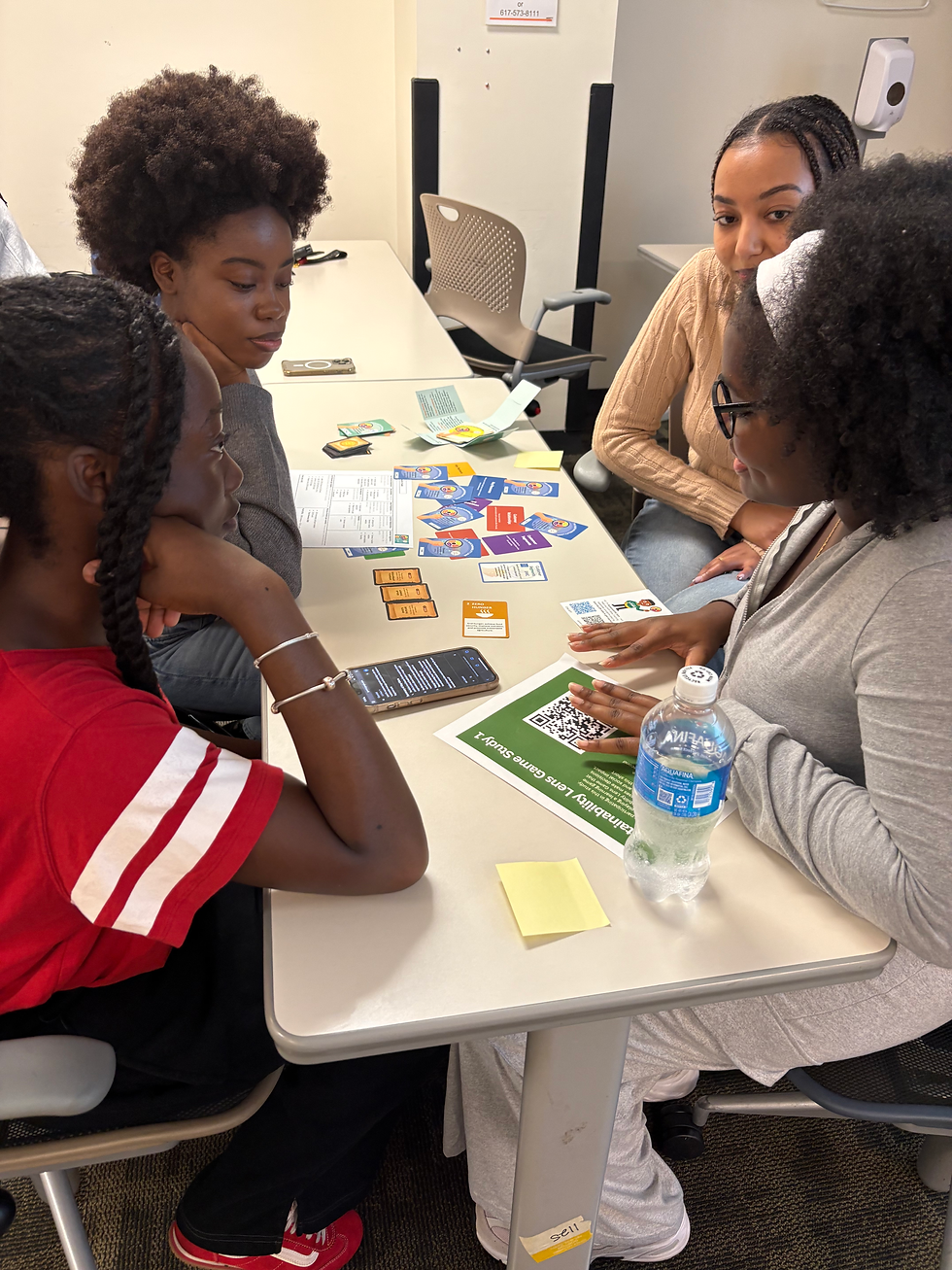
4) Offers gamified, team-based application through the Sustainability Lens Game
Instead of leaving sustainability theory in the abstract, the book introduces the Sustainability Lens Game as a collaborative method for idea generation and problem-solving. Prompt cards and “Gold Coin Ideas” enable mixed-experience teams to co-create sustainable business solutions quickly—useful for classroom participation, workshops, and interdisciplinary cohorts.
5) Reframes the SDGs as innovation constraints—not a compliance checklist
A particularly helpful instructional move: the SDGs are presented as design constraints inside the Business Model Canvas. Rather than treating SDGs as moral add-ons, the approach shows how constraints can reveal unmet needs, reduce long-term risk/cost, and open new revenue logic—an angle that tends to resonate with students who want both impact and viability.

Why it works for academic contexts
If you teach social entrepreneurship, sustainability strategy, or innovation, you’ve likely seen students struggle in three areas:
Turning values into viable design choices
Connecting sustainability frameworks to business mechanisms
Communicating credible value without greenwashing
The Profitable Good stands out because it is explicitly built to help learners move from framework → application → iteration, using tools they already encounter (like the BMC) while expanding what “good business design” can include.
A simple way to use it in your course
If you want a low-lift entry point, try this sequence:
Have student teams build a baseline Business Model Canvas.
Introduce the book’s sustainability lenses and ask:“What must change in the model when People, Planet, Profit, and Purpose are treated as simultaneous design requirements?”
Run a short Sustainability Lens Game session to generate alternatives and improvements.
This creates a repeatable loop: model → critique → redesign, which aligns well with experiential and project-based pedagogy.
Closing thought
For academics, the promise of The Profitable Good is not that it simplifies sustainability—but that it makes sustainability teachable, actionable, and strategically legible inside business design.


Comments