Innovating for Sustainable Growth: Looking Ahead to ICARMBT 2026 in Delhi

I am honored to be presenting at the International Conference on Advanced Research in Management, Business and Technology (ICARMBT 2026), which will take place April 7–8, 2026 at Ram Lal Anand College, University of Delhi South Campus in Delhi. This year’s conference theme, “Innovating for Sustainable Growth: The Convergence of Business, Management, and Digital Technology,” creates a timely and exciting space for conversations about how we build ventures and organizations that are both resilient and regenerative.
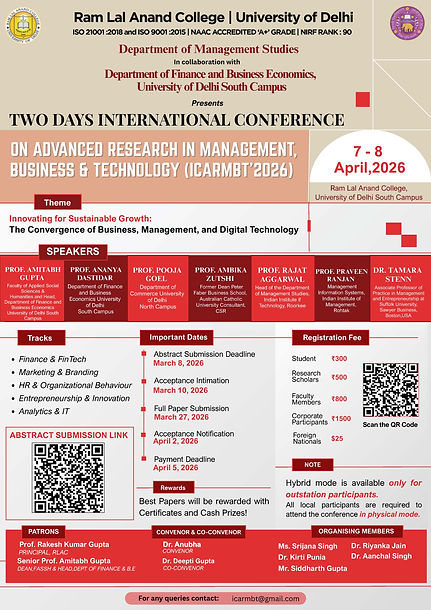
My presentation, “Innovating for ICARMBT 2026,” brings together ideas from my work on my new book, The Profitable Good, the Sustainability Lens Game, and regenerative sustainable business model innovation (reSBMI). ReSBMI is a new concept I write about in an upcoming book chapter. The heart of the talk is a simple but powerful idea: sustainable growth happens when business logic, experiential learning, and regenerative thinking work together. In other words, sustainability is not an add-on. It can become part of the core architecture of how organizations create, deliver, and capture value.
One part of the presentation focuses on The Profitable Good, which treats sustainability as a strategic advantage rather than a compliance exercise. This approach shows how sustainability can be embedded across operations, customer relationships, finance, leadership, and partnerships. By grounding these ideas in the Business Model Canvas, the framework helps move sustainability from abstract aspiration to practical decision-making.
Sustainable growth happens when business logic, experiential learning, and regenerative thinking work together.
Another part of the presentation explores the Sustainability Lens Game as an example of AI-enabled experiential learning. The game combines sustainability tools, the Sustainable Development Goals, and business model thinking to help learners generate and test new ideas quickly. In the presentation, I describe how this kind of tool can help students and practitioners move from theory to action by encouraging systems thinking, collaboration, and creative problem-solving.
I also discuss how this work connects to regenerative business model innovation. The goal is not only to reduce harm, but to imagine enterprises that restore and strengthen the social and ecological systems they touch. For management education, this means giving learners opportunities to practice working through trade-offs, uncertainty, and innovation challenges before they face them in real organizational settings.
I am especially pleased to be part of a conference that brings together scholars and practitioners across areas such as entrepreneurship and innovation, analytics and IT, finance and fintech, marketing and branding, and HR and organizational behaviour. That interdisciplinary setting is exactly what today’s sustainability challenges require. The most promising solutions often emerge when we connect management insight, technological tools, and a deeper commitment to human and planetary well-being.
I am grateful to Dr. Riyanka Jain, Assistant Professor, Department of Management Studies, @RamLalAnandCollege, in collaboration with the Department of Finance and Business Economics, University of Delhi South Campus, for creating this forum. I look forward to sharing ideas, learning from other presenters, and contributing to the conversation on how business and technology can support sustainable growth in meaningful, practical ways.
#DFBE #UniversityOfDelhi #ICARMBT2026 #ResearchConference #Finance #FinTech #SustainableGrowth #Innovation


Comments